


2
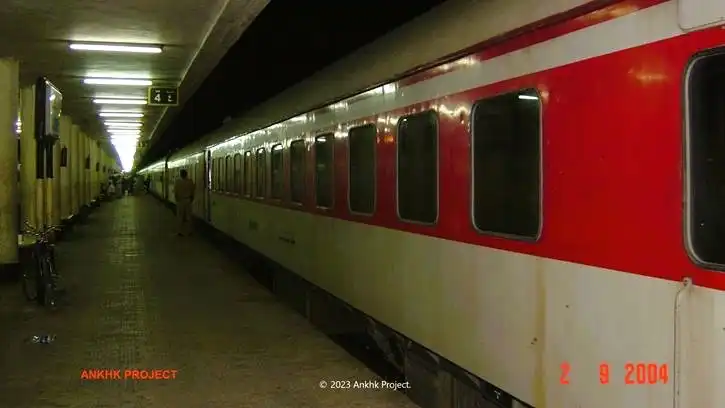
And... to travel far while spending little, the train was, without a doubt, our best choice.
Where... we imagined we would have a peaceful night’s sleep, eight (8) full hours between Cairo and Aswan. However... reality had other plans! No one got any sleep, as all our luggage was separated from us, and worry* took over, outweighing any attempt to rest!
* The result? A classic rookie mistake! In the end, nothing happened to our bags, everything arrived in our hands completely safe. All that was left was to regret our unnecessary anxiety and our typical tourist inexperience, facing a new day that would be long… and practically sleepless.
Photo credit: Our records - Egyptian Train - Egypt - 2004.
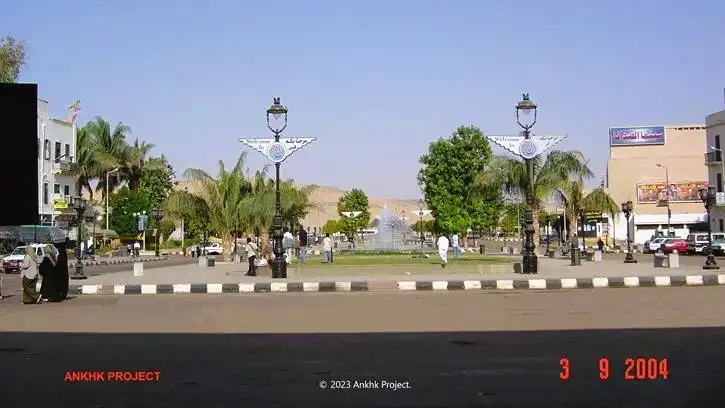
Once in Aswan... it was time to gear up for a true and thrilling tourist adventure, exploring as many places as possible*, with no guides, no hotel reservations, no transfers, and no scheduled entries. Pure exploration!
And for that… we would start with the breathtaking Temples of Abu Simbel, then board a mid-sized ship for a cruise along the legendary Nile River, heading toward Luxor. Unforgettable days awaited us, sailing through its historic waters, making strategic stops at iconic sites, and soaking in the mesmerizing scenery of that splendid river.
* At that time, unfortunately, the Dendera Temple was closed to visitors.
Photo credit: Our records - Aswan City - Aswan - Egypt - 2004.
Reference: Aswan (Britannica, The Editors of Encyclopaedia. "Aswān".
Encyclopedia Britannica, 31 May. 2016, https://www.britannica.com/place/Aswan-governorate-Egypt. Accessed 30 June 2023.).
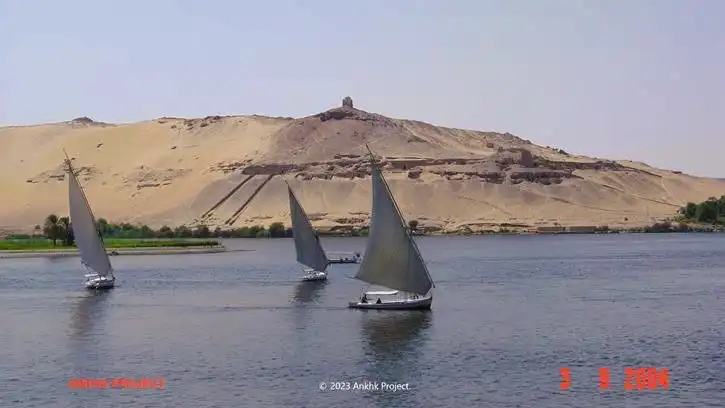
Look at this view...
The majestic Nile River, the elegant "Fellucas" gliding over the water, the Tombs of the Nobles standing against the desert, thousands of years of history captured in just "one scene". And what can we say? It was all simply as stunning as it was rewarding! We were so happy to be there that, on its own, that feeling would have been enough to make the trip worthwhile.
But in real life…
We can’t just admire beautiful landscapes without doing something truly meaningful, even on a simple tourist trip. Becasuse even when we experience the best moments of our lives, sometimes, we need to push forward... even if all we want is to take it all in. And that was exactly why the magnificent Temples of Abu Simbel were waiting for us. The catch? We had no idea what was coming... not yet!
Photo credit: Our records - Nilo River - Aswan - Egypt - 2004.
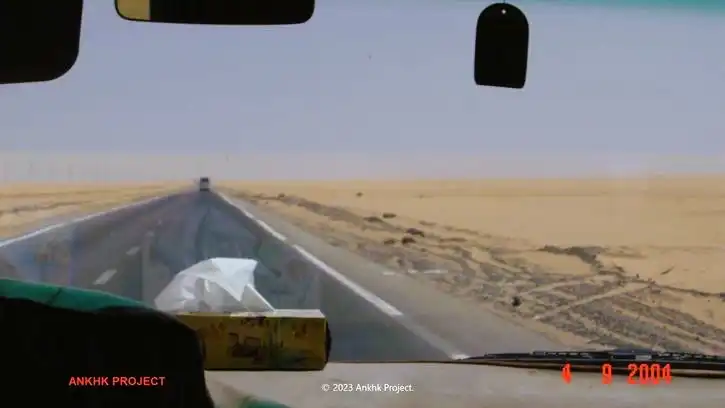
Well, if our path led to Abu Simbel, then that’s exactly where we had to go...
It wasn’t too close to Aswan, but not too far either. The problem? The route was considered a bit dangerous at the time, as we had to cross the desert. And, as expected, that area was known for major security issues. However, there was no other choice, no plan "B". The only option was to move forward and face that tense journey.
But in the end, everything turned out fine... because the Egyptian army was with us the entire way, both going and coming back! Look ahead, there’s a military truck leading the way, and another one right behind us!
So, we just to have to thank you, thank you so much!!!
Photo credit: Our records - Aswan Desert - Aswan - Egypt - 2004.
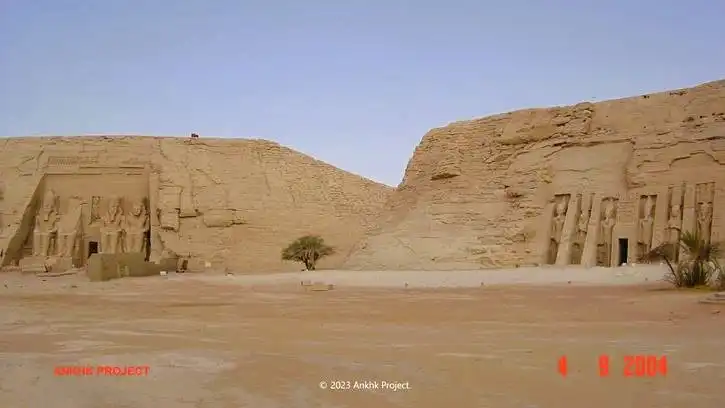
Finally, we arrived at the famous Abu Simbel, the magnificent legacy of Great Ramses II and his wife Nefertari, where we could admire their impressive temples: Ramses II’s temple on the left, and Nefertari’s on the right.
So… let’s move forward! There’s still so much to explore, both inside and out. But we must be quick, time is short, and we need to return while daylight still guides our way!
Now... let’s move forward, because this is exactly when everything begins to change!
Photo credit: Our records - Abu Simbel Complex - Abu Simbel - Egypt - 2004.
Reference: Abu Simbel Complex (Mark, Joshua J.. "Abu Simbel." World History
Encyclopedia. World History Encyclopedia, 09 May 2018. Web. 23 Jun 2023.).
Yes... we are finally beginning our long journey!
A journey where we will describe each of our steps, just as we did on this trip to Egypt, sharing all our doubts, uncertainties, and, most importantly, our still limited understanding of what was truly in our hands at that moment. In this next step, we will uncover our "first clue" about the complex algorithm mentioned in our introduction. However, at this point in our journey, keep in mind that we still had no idea what it really meant. We only noticed an intriguing detail... something that could be new, hidden behind those hieroglyphs (as we will see later). So, just in case, we took a few pictures to document it!
So, let’s see what happens next... and don’t worry, we still have 65 more steps to put all the images into context!
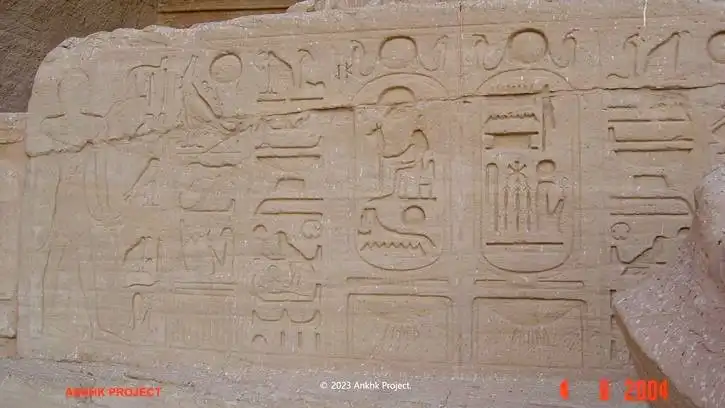
Ok, let's get started...
When we were outside those temples, observing the surroundings and taking advantage of that unique opportunity, we decided to try translating some hieroglyphs, just for fun. But, to our surprise, we found much more than we expected!
Now, to make this experience more tangible and realistic for all of you here, let’s analyze this photo, which captures exactly what we saw that day. Therefore, in the sequence, we ask the following question: tell us, what do you see?
Yes... here, we can encounter three possible scenarios: the first, if you are an expert; the second, if you are someone totally unfamiliar with the subject; and lastly, the third, if you were like we were at that moment, studious and determined, but still facing great challenges in the interpretation process. So, understand this: interpreting something without having full mastery of the context can be a real emotional roller coaster, where the right or wrong is random. And this is exactly where everything connects...
Because our difficulty in reading those hieroglyphs led us to go beyond, to search for improbable and creative solutions, looking around and thinking completely outside the box. This was exactly what we did in our daily work: we analyzed, interpreted, decoded, worked with data, and mainly numbers in all their forms. And, although archaeology was not our main activity, it always played an important role in our lives.
Now, after all this reasoning, it’s essential to highlight something crucial: maybe, and just maybe, this lack of specific knowledge, this shortage of experience in translation and interpretation, is what allowed us to see something that no one else had seen. And that’s why we asked right above: look at the photo, and tell us, what do you see? Now it’s clear why we asked the question? Because at that moment, our "solution" for the translation was exactly what we were seeing, just as you are trying to answer our question. But of course, this depends on your level of knowledge: if you are a layman, you won’t understand anything at all; if you are an expert, you’ll translate with ease and precision; but if you’re in between, you’ll probably try to see it like we did, where the most plausible solution would be the one you are "seeing", although we knew that our interpretation was somewhat far off from what anyone might propose.
Therefore, discovering something "out of the ordinary", something "beyond the obvious", in the face of our visible difficulty, actually led us to find a "solution" for our challenge, which was the lack of technical knowledge at that moment.
And so... you managed to understand the interesting and somewhat peculiar circumstances that led us to the discovery of the algorithm we mentioned? And understand this... at the time, we didn’t even imagine that that first clue would lead us to something related to an algorithm. We were just at the tip of a huge iceberg that only fully revealed itself 18 years later. But for now, don’t worry about fully understanding this initial clue. Just keep moving forward, because much more is yet to come!
Photo credit: Our records - External Hieroglyphics - Abu Simbel - Egypt - 2004.
Initially, we were there to experience what we had always wished for in our lives, after all, it was our dream trip, but... suddenly, everything changed! And when did that happen?
It was the moment we found something specific about those hieroglyphs, versus what specialists would be translating, and this only happened because of our lack of specialized knowledge. The big question here is that... what might have been right for us, perhaps wasn't right for many!
Another factor that reinforces this “new observation” relates to the circumstances... because it is completely different to see something in front of us, like those hieroglyphs outside the Temple of Ramses II (which you can see in the image from step 16 above), compared to what we could only see in books.
Let us be clearer... notice that, when looking at images in books, in this case, hieroglyphs, the natural behavior is to immediately look for their meaning, and it is usually right below, or somewhere close by. We know that this information will almost always be within our reach, so we don’t need to worry about translation, even if we are experts in the subject. And this is very similar to watching a movie in the cinema or on TV, where the language is not our own. And the question is... what do we do first? Of course, we look for the subtitles, even if we can understand the language. And only much later, "maybe much later", do we try to understand what is being said without the subtitles. Got the concept? If not yet, follow along below!
Therefore... from this unique experience, occurring outside the Temple of Ramses II, where we believe only that location could have given us, we began to follow our own steps, searching for new clues that could either confirm or refute our “first important observation”, which was nothing more than the fruit of our own translation of what we saw, not what the books could have told us. Yes, because since we had visualized something so different and unique, this role would be ours!
Got it? We hope so. Either way, we still have plenty of time to clarify many things... let’s continue!
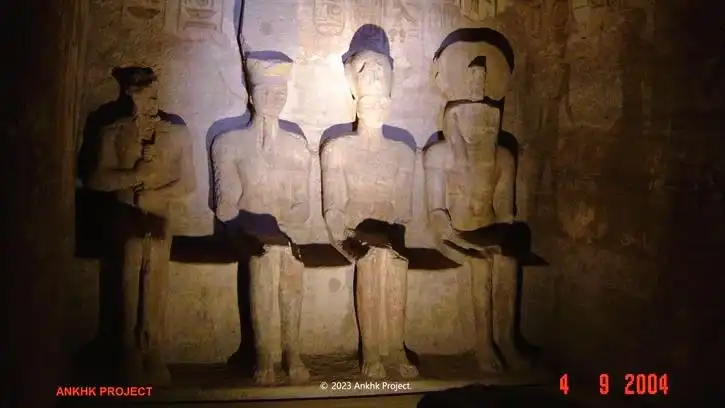
OK, let's continue our journey through these temples, but now with something a bit more complex and, without a doubt, more intriguing.
Take a good look at this photo... but now, no more mysteries, let's quickly explain what it reveals!
This is a crucial point at the end of Ramses II’s Temple. And when we say "at the end," we mean way at the back, deep inside the temple's depths. Well, this location has a fascinating feature: it is illuminated by sunlight only twice a year (see the photo above). Now, consider that these sculptures are located precisely at this strategic point, and the temple is immense, with great depth, leading us to confidently say that: without a doubt, we are facing a masterpiece of architecture, created a staggering thousands of years ago!
Now, let's return to the image... From left to right, we see the representations of the Egyptian Gods, along with Pharaoh Ramses II: Ptah, Amon-Ra, King Ramses II, and Ra-Horakhty.
Well, what does all of this tell us about our search for new clues?
It might say something new and intriguing, because, within our new concept, according to our new interpretation, we see that this representation was made in such a unique and engineered way, with so much grandeur, that it might reveal something much deeper about Ramses II than we imagined. Perhaps the simple fact that he was venerated and adored and, therefore, depicted as a "god" sitting next to three other very powerful ones, is not the only explanation for this representation. There might be something more behind it, something beyond what we could have assumed. Something that made him truly unique and incomparable! Yes, something grand and, at that time, still an unexplained question!
Now understand that... we only managed to fully comprehend this with clarity and conviction, nine (9) years later, after extensive work, and certainly with the help of everything we will still see ahead.
Photo credit: Our records - Sanctuary Ramses II Temple - Abu Simbel - Egypt - 2004.
Reference: Sanctuary of the Temple of Ramesses II
(Raddato, Carole. "Abu Simbel, Sanctuary of the Temple of Ramesses II." World History Encyclopedia. World History Encyclopedia, 15 Mar 2022. Web. 30 Jun 2023.).
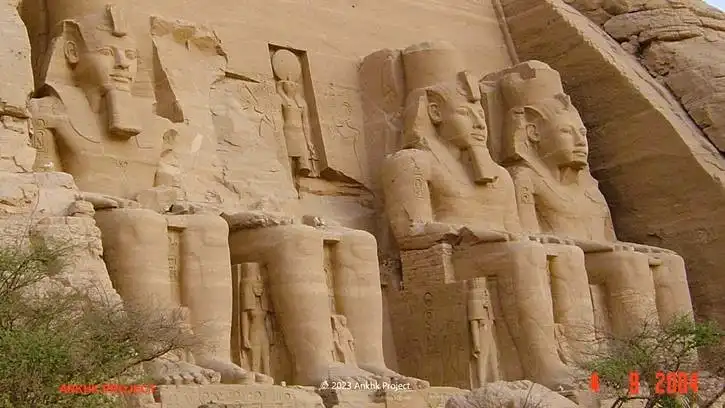
Now, returning to the outer side...
We are once again faced with the entrance of Ramses II’s Temple, the same spot where we had passed just minutes before our "important observation". However, and definitely, now we were looking at this place with "new eyes", with a fresh perspective.
Therefore, just as we did that day, take a look at the image of this gigantic monument!
Incredible, right? Majestic, imposing... however, now we can realize, after our discovery, that the most important aspects are not hidden in the grandest forms, but rather in the small and decisive details!
So, let's make the process easier for you, getting a little closer to the entrance in this next step, so we can present our exact vision that day, revealing what might have gone unnoticed at first glance.
Photo credit: Our records - External Ramses II Temple - Abu Simbel - Egypt - 2004.
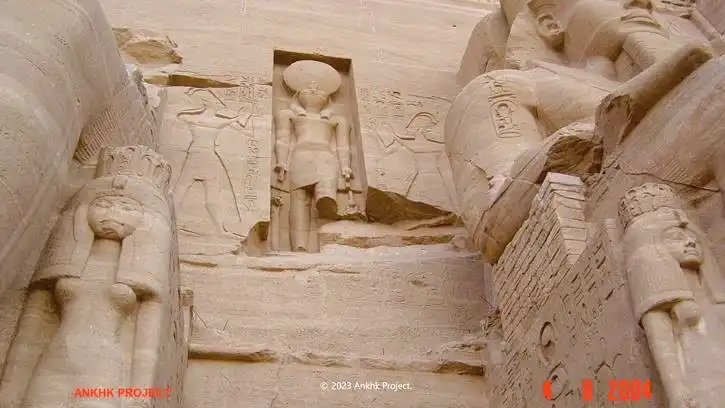
Ok, pay close attention now, and focus on the details, and see if you can identify something similar to what we saw in our photo above from Step 16, where we revealed our "first clue"! And don't forget to explore every point carefully.
And remember...
You must think completely outside the box, so... focus on the details, because that's exactly why, on that day (with a new perception), we took this photo! Yes, take your time, go back to the image from Step 16 as many times as you need, and you will surely notice what we're highlighting soon!
Photo credit: Our records - Front Door Ramses II Temple - Abu Simbel - Egypt - 2004.
If not, that's okay, it might be difficult to notice at first glance in the same way we were lucky enough to visualize that day, and moreover, to understand the context behind it, even if superficially!
OK, now let's continue with our steps, as much more will be clarified as we move forward!
Thus, after taking the photo above (Step 20), and acknowledging that we found our "second clue", we realized that we might, but have not yet confirmed, have only one main observation about the hieroglyphs, but now with two different clues, both connecting with the "same scenario"... but, from different perspectives... interesting, isn't it?
OK, let's move forward, as many things are yet to come, and we still don't have anything substantial in hand!
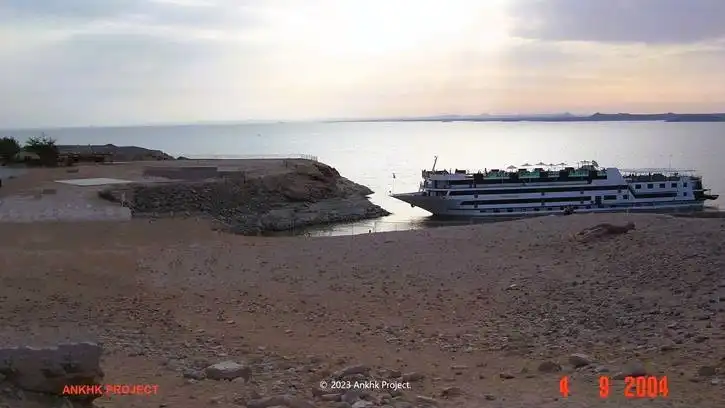
OK, the sunlight was fading and a vast desert was awaiting us!
Upon arriving in Aswan, we would take a boat for a cruise on the Nile River towards Luxor (as mentioned before), spending a few days on the ship and stopping at various points, however... now we had a new proposal in mind... something we needed to solve:
Photo credit: Our records - Lake Nasser - Abu Simbel - Egypt - 2004.