



11
Yes, the years went by, and this allowed us to review some of our most important results with greater clarity...
Based on these reviews, we set new goals with a clear purpose: the search for solid evidence. However, we were not interested in superficial clues, we were pursuing concrete proof, with direct and personal access, just as it happened with our first piece of evidence, currently displayed at the MET Museum in New York (Step 49).
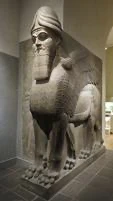
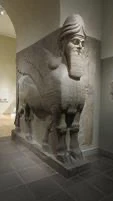
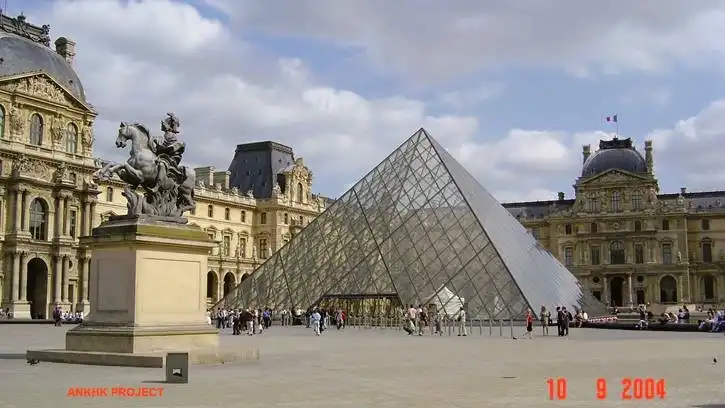
We knew our mission wouldn’t be easy, especially given the complex themes and the ancient times involved. Even so, we explored nearly everything within our reach. And it was during one of these analyses that we came across the extraordinary and iconic Louvre Museum located in Paris.
Known worldwide, the Louvre houses a vast collection and astonishing exhibitions on display. We had the honor of visiting it just a few days after returning from Germany, on our journey back from Egypt in 2004.
Among its most emblematic pieces, in the course of 2015, we identified a truly remarkable piece of evidence, strikingly similar to the one we presented earlier, which was the “Famine Stela of Djoser” (Step 63), which helped us uncover the secret of the Great Sphinx of Giza. This time, however, we were not dealing with an Egyptian pharaoh, but with another historically significant figure: the powerful king Hammurabi (1792–1750 BCE) of the Babylonian Empire. He personally describes, in detail, the context of this new evidence, which is recorded on an extraordinary piece. So, let’s delve deeper into all of this in our next steps!
Photo credit: Our records - Louvre Museum - Paris - France - 2004.
References: Louvre Museum (Paris). / Hammurabi (Renger, Johannes M., Britannica,
The Editors of Encyclopaedia. "Hammurabi". Encyclopedia Britannica, 16 Jun. 2023, https://www.britannica.com/biography/Hammurabi. Accessed 12 July 2023.) / Hammurabi
(Mark, Joshua J.. "Hammurabi." World History Encyclopedia. World History Encyclopedia, 16 Apr 2018. Web. 12 Jul 2023.).
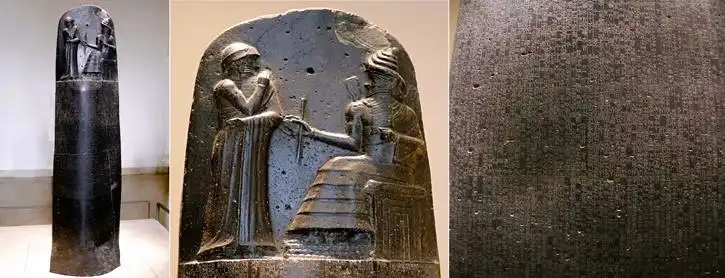
Here it is, in the most detail that the photographs allow, this valuable piece, known as the Code of Hammurabi. It is made of a black basalt stele containing about 282 inscribed laws, which are attributed to the Babylonian king Hammurabi (First Dynasty - Mesopotamia). This piece was discovered in 1901 at the archaeological site of Susa, in Iran.
Yes, this is one of the first* collections of "legal texts" ever found in human history. At the top of the stele, we see King Hammurabi standing before the "god Shamash", the Babylonian "God of the Sun". This god also held the titles: "Judge of Heaven and Earth" and "Lord of Judgement".
The Code of Hammurabi itself is a collection of 282 legal texts that governed and guided most of the "Laws of Babylon", the first great metropolis known in the ancient world. Accessing all the content of this piece, we can see that these laws were dictated directly to King Hammurabi by the "god Shamash", and thus, this stele was fully conceived.
From these laws, a famous popular saying emerges:
* Earlier collections of laws include the Codex of Ur-Nammu (2100 - 2050 BCE); the Codex of Eshnunna (1930 BCE); and the Codex of Lipit-Ishtar (1870 - 1860 BCE), all mentioned in the references listed below.
Now, let's move directly to the next step, where we will clarify the reason why this piece is among our most important pieces of evidence.
Photo left credit: Hammurabi, CC BY 3.0, via Wikimedia Commons. /
Photo center credit: Hammurabi, CC BY 3.0, via Wikimedia Commons. /
Photo right credit: Hammurabi, CC BY-SA 3.0, via Wikimedia Commons.
References: Code of Hammurabi (Britannica, The Editors of Encyclopaedia. "Hammurabi". Encyclopedia Britannica, 07 Jul. 2023,
https://www.britannica.com/topic/Code-of-Hammurabi. Accessed 12 July 2023.) / Code of Hammurabi
(Mark, Joshua J.. "Code of Hammurabi." World History Encyclopedia. World History Encyclopedia, 24 Jun 2021. Web. 12 Jul 2023.).
Well, before discussing what makes this piece worthy of our evidence list, let's briefly revisit the content of the "Analogy" presented in our Step 51, as well as share an important observation...
As previously stated, our response to the "algorithm" found in Egypt can be applied to various cultures, provided they experienced the same "scenarios" lived by the Egyptians throughout their different dynasties... and this became quite evident! The proof lies in the fact that, upon analyzing other cultures, we found several evidences, presented in our Step 57, which expanded our list beyond the Egyptians, including: Persians, Akkadians, Syrians, Hittites, Elamites, among others. Now, with this new evidence, we can confidently include the Sumerians as well. These peoples, with the exception of the Egyptians, coincidentally lived in the region known as Mesopotamia.
That being said, another point that caught our attention was the fact that only the greatest and most influential cultures of antiquity coexisted with these "scenarios" we've analyzed. And for this reason, among others we have yet to reveal, these cultures remained at the "top" of the power hierarchy, above many others spread across the world. Therefore within this select group, we can already anticipate: certainly the Greeks and, especially, the Romans are also part of it.
Now, after these brief explanations, let's reflect... do these two paragraphs above already answer our central question here? Namely: why did we collect this new piece as an evidence? Or, more directly... where in this piece are our codes, the clues similar to or connected with everything we've already discovered?
Yes, we acknowledge that answering these questions without the support of our "Research Book," and without the possibility of seeing this piece in person, makes everything much more challenging. However, follow along with the analysis we'll present next, and everything will start to make complete sense!
So, did you find any answers?
Yes, it's the information itself.
These 282 laws didn't appear out of nowhere. They establish rules of power, and in this context, power is not just another clue... it's one of the most relevant.
Because, who holds power, governs everything and everyone! And this power can be represented in grand ways, like these "laws," or, bringing it to present times, through more subtle means, such as: "I have and hold the technology", thus, I have a total advantage over you. And those who don't possess it, which is the majority, simply pay to have it.
Now, we might ask ourselves... is this wrong? And the answer is simple: of course not! The world has always been the world, and will continue to be as it is, because that's how it functions best!
Have you now realized, even more clearly, why we can't expose our discoveries openly here on the Internet? As we've said, what we've discovered applies to both our most distant past and our present, our daily lives. Therefore, our two (2) final revelations, which will be presented exclusively in our "Research Book," are, in fact, much greater than simply discovering our "most probable" past.
Yes, we understand: everyone wants the coordinates of the "Eden Region," the "Garden," to know the fate of the Ark, the secret of the Sphinx, of Enoch, and of Göbekli Tepe. But think... knowing about this now will be just a detail compared to what is truly among us. The most important thing is that we've already discovered all of this, and it's practically in our hands. However, these two final revelations, not yet disclosed, need time and understanding to be fully assimilated, something that can only be achieved by reading, in full, the pages of our "Research Book." Remember that our seven (7) "blocked contents" literally reveal, to those who are more attentive, these six (6) first answers, and more, the answer to the "algorithm" as well!
Exactly, that's why we brought this work in a semi-open format to the Internet: so that everyone can know and help disseminate this content. Because only with this prior understanding will we develop the expertise needed to achieve this greater goal. Therefore, share this work, discuss what we've presented here, and if by chance you manage to partially discover what we're trying to convey, congratulations, you're on the right track!
Okay, let's return to the analysis of the Code of Hammurabi...
Did you notice that all the content of these 282 laws was transmitted directly from a "god to a king"?
So well-crafted and intelligent, considering we're talking about 1,700 years before Christ, that many of them still serve today as a foundation for current laws. And what’s even more relevant: these laws are not credited solely to King Hammurabi. According to him, these norms were dictated by a “god” who, in theory, directly intervenes in the entire social structure. A god who appears “out of nowhere” and declares: "follow this", and everyone follows, coherently and faithfully!
So... were you able to grasp the scope and depth of this context about transmitting a certain power? Did you notice that the Egyptians also lived under very similar structures?
If not yet, don’t worry, this is completely understandable, as understanding certain aspects is not that simple. However, in the next step, we’ll present new evidence that will clarify everything much better.
So... let’s move forward. And remember our words, because they matter. In the end, everything depends more on you, the readers, wanting to know the truth, than on us, for everything has already been done and is in our hands, ready for more experienced and qualified specialists to analyze, validate, or even challenge our findings. Now, let’s move on...
Back to Egypt now, to the time of King Thutmose IV...
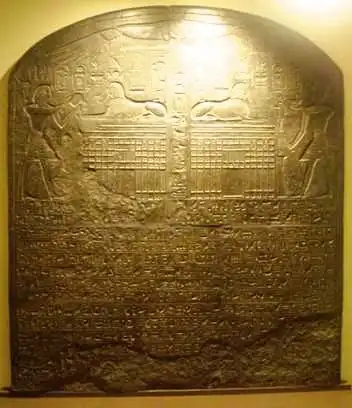
Yes, this is a replica of the Stele of the Dreams of King Thutmose IV (1400 - 1390 BCE).
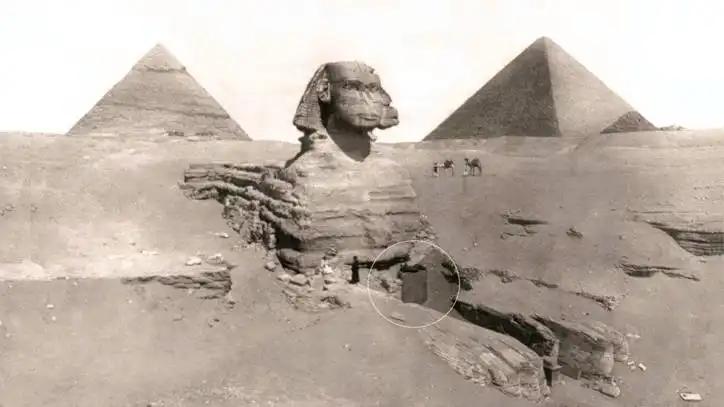
And for those of you who may not know or have never heard of it, it is positioned between the front legs of the Great Sphinx of Giza (as seen in the image below).
This stele contains the record of a fascinating episode involving the then, prince Amenhotep II, the future King Thutmose IV. So, follow along with us as we explore this brief but revealing story:
Now, let's move on to our conclusions.
Photo credit: User:Captmondo,
CC BY-SA 3.0, via Wikimedia Commons.
Reference: Thutmose IV (Britannica, The Editors of Encyclopaedia. "Thutmose IV".
Encyclopedia Britannica, 25 Mar. 2009, https://www.britannica.com/biography/Pharaoh-Thutmose-IV. Accessed 12 July 2023.).
OK, the story may seem, in some ways, incredible, enigmatic, and even fanciful to some. But... it's not just that! The text reveals exactly what we need to identify so that we can once again recognize the same situation presented in our previous evidence. Observe:
A god, in this case, the "god Horus" (the falcon god), talking to a "prince" (since Thutmose IV was still a prince at that time), who would become king if the request made by the sphinx, represented by this god Horus, was granted.
And moreover... this also happened with the event recorded in the "Stele of Famine of Djoser" (Step 63). Although we haven't addressed it, the god Khnum, the god of the Nile River's source, also converses with "Amhotep", telling him what to do to finally end the seven (7) years of drought and famine that were ravaging Egypt.
Very well, now that we have contextualized all of this, let's move to a crucial question...
Where all are depicted on stele, meaning "engraved in stone, engraved forever", occurring in different time periods, in distant locations, including two in Egypt and one in Ancient Sumer, even though they are so distinct from each other, don't they present "too many coincidences" for there not to be a direct and deep connection between them?
So, stop and reflect on that!
Meanwhile, let's move on to the next six (6) steps below, which will be our last ones. Who knows, they might add something important to your search for this specific answer!
But before we continue, a curious fact... did you notice how the sands of time still insisted on covering the Sphinx? This image is from 1893 (3,000 years after Thutmose IV), and if you notice, once again it was almost completely covered... interesting, isn't it? A little tip for you! Now, let's move on...
Photo credit: Miscellaneous Items in High Demand, PPOC, Library of Congress,
Public domain, via Wikimedia Commons.
Reference: The Great Sphinx of Giza (Mark, Joshua J.. "The Great Sphinx of Giza." World History Encyclopedia.
World History Encyclopedia, 26 Oct 2016. Web. 12 Jul 2023.).
Yes, unfortunately, the time has come to close... at least for now!
It has been a journey where we tried to bring you the maximum possible revelations. Even without our Research Book, you have definitely been able to access the best possibilities of information, as well as solid evidence, forming an excellent logical structure, all within our main goal: to present everything that will certainly come to light!
Remember that our seven (7) "locked contents" will be your key. So, carefully observe these last four (4) pieces of evidence, the two (2) previous ones, and the two (2) that will follow. Read and listen as many times as necessary to our sets of verses, and understand what has always been right in front of us, even before we simply wanted to know about our past, which will no longer be a question mark.
We thank the Luxor Museum, King Amenhotep III, the god Sobek, and finally, the Griffith Observatory, which symbolizes our broadest evolution!