



7
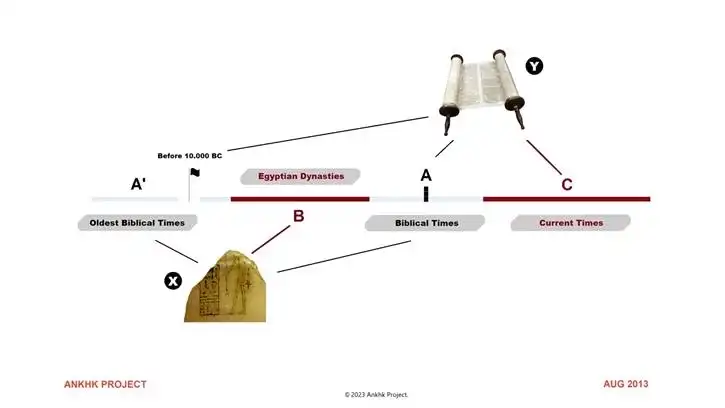
As should have been clear earlier, after analyzing various ancient texts, we realized that the Biblical Book, regardless of its versions, would be our only alternative to find a possible origin for our complex context. From this realization, we began inserting various comparative parameters between its events, in order to evaluate all points that were similar or compatible. Therefore, focusing only on the final result, we quickly identified the analogy above, which is completely aligned with our response to the "algorithm".
Thus, we will now transform this figure into a kind of relational equation, to explain more clearly how we got here. However, before that, an important observation is worth mentioning...
Pay close attention to the date of Ten thousand (10,000) BC, presented directly on the timeline, indicating: "Oldest Biblical Times!".
And this involves a series of aspects, such as Adam's Descendants, directly related to the discovery of the "Garden," as well as the "Flood of Noah", which is closely tied to the context of the "Eden Region", where the famous Ark was built. For, theoretically, we were able to locate this exact site, just like the Garden of Eden, with its geographical coordinates. Therefore, by studying various aspects of this "Garden," we were able to determine its likely "origin date," that is, the possible beginning of our civilization, as active and thoughtful as we are today.
As a result, all the events studied from the discovery of the "Garden of Eden" were dated, reaching the possible construction of Göbekli Tepe (9600 BC) in Turkey, a settlement most likely post-diluvian, following a series of ancient cities. Where we can illustrate with examples: Jericho (Palestine - 8000 BC), Çatalhöyük (Turkey - 7500 BC), Nineveh (Iraq - 6000 BC), Tell Aswad (Syria - 5000 BC), Byblos (Lebanon - 5000 BC), Aleppo (Syria - 5000 BC), Uruk (Iraq - 4000 BC), Babylon (Iraq - 1900 BC), among others.
Therefore, if this work is correct, we will be connecting the beginning of human history with the evolution of that same history!
Well then, let's analyze our analogy, which presents a view, yes, summarized, but very effective of what we found as a response to our "algorithm", leading us to a very, very distant past...
Where:
X = Algorithm Answer | Y = Biblical Book | A' = Oldest Biblical Times | A = Biblical Times | B = Egyptian Dynasties | C = Current Times
We have:
(X is to B, just as A and A' are to X), and, (Y is to C, just as A and A' are to Y), so if (B and C are to X and Y, respectively), and (both X and Y are results of the union of A and A')... we have that B and C can be "equal", or in other words, we have the "same scenarios", not only when looking at the biblical sense (where, theoretically, we all came from the same origin), but also when considering the meaning of our "response to the algorithm."
And then, even though it is just an analogy, based directly on relationships, did it become clear to you?
Obviously, not completely! We know that there are still many details, which we will address later, but for now, keep in mind this distribution image. Now, regardless of the next steps, let's summarize in a few words what you really need to know about this scenario, and that everyone, in the end, will certainly understand!
Now get ready, because for the first time, we will present protected content! Thus, as mentioned back in our Step 1 ("Before starting your journey"), everyone already knows how to proceed!
PROTECTED CONTENT !
Image Credit: Our records - Featured illustration / Image "X": British Museum, CC BY-SA 3.0, via Wikimedia Commons. / Image "Y": HOWI - Horsch, Willy, CC BY-SA 4.0, via Wikimedia Commons.
Reflecting solely on the "algorithm," we can understand that... if our conclusions are correct, our response to what we've discovered might not only correspond to the period of the Egyptian civilization, but also encompass any other period and existing civilizations, as we already presented in the timeline above, suggesting that this premise could even extend to the present day.
Remembering (Step 46)... this is why we mentioned that the "ritual vessel", our first evidence, might not only inform us about the period in which it was conceived (perhaps in the time of Narmer), but also continue to reveal something important for thousands of years after its creation.
Now, talking about a complete understanding that everyone would like to have about our "response to the algorithm", something you’re probably wondering right now... it’s crucial that everyone knows that:
If you "deduce" any of our answers that have not yet been clearly presented in this work, please, first, be completely sure about your own conclusions and second, please, don’t alter your logical and coherent view of life and everything you believe and have learned about it. For both this work and the context we will present in our "Research Book" represent "a possible" historical reality, technically and practically speaking. Without greater or lesser consequences, presenting only, and possibly, where we came from and perhaps where we should go. Simply put, without alarm or problems, because, deep down... we all knew that this moment would eventually arrive. And here we are!
OK, let’s pick up where we left off, continuing with our clarifications about our "analogy," because, surely, it will be of great value in your search for immediate answers!
So, is it clear about the results of our analogy? Because, if we’re right, theoretically, we will find more codes similar to the ones we found in Egypt, and in other civilizations, in similar periods or even in other moments of our history.
Therefore, based on this reasoning... we started a new search for something that would bring us more "traces" of our response to the "algorithm," but now applied to other cultures beyond the Egyptian. And as a result:
Another important point concerns the moment when these cultures simply "ceased" to inform in carvings, papyri, cylinders, etc., the scenario they were experiencing. We realized that, the closer to the "year zero" (remember the "year zero," Step 23, "AD" = "Anno Domini", The Year of Our Lord), the less common these informations were exposed, which gave us the clear conviction that... "informing about this scenario, yes, was no longer viable, nor safe!" And that’s why, today, two thousand (2000) years after this "year zero," we, here in this work, still have a great fear in revealing this discovery! (read our first blocked words – Step 51, above.)
Therefore, let’s check these important clues in the upcoming steps.
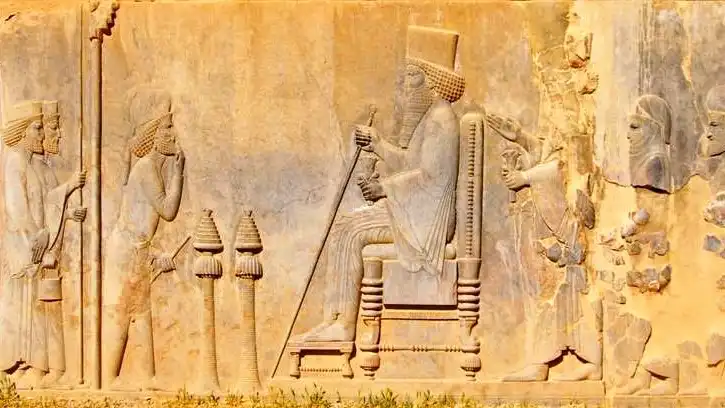
OK, let's start with a period of time close to year zero. Then, we will go back as far as possible, exploring more distant periods, but always focusing on our clues!
To begin, we will focus on two (2) characters of great importance, with a culture completely unrelated to the Egyptian one. We are talking about Great Darius I and his son Xerxes. Both belong to the Achaemenid Persian Dynasty (559 - 330 BC), whose highlight is the Great Persepolis, an ancient and important capital located about 50 km (30 miles) northeast of Shiraz, in the southwest of Iran.
Now, let's directly analyze the image...
Very well... once this image has been clearly verified, the question that remains is: where are our clues? Where are the codes identical or even similar to those found in Egypt?
To reach this simple conclusion, we just need to replace the apparent flower that both carry in their hands with our well-known Egyptian symbol "Ankh"!
Did you notice? Any doubts about that?
Notice that, with little effort, we are able to clearly visualize this scenario, a scenario very similar to the one we repeatedly find in Egypt. There, only kings, queens, and gods carried the "Ankh symbol" in their hands (see the image in Step 31). Therefore, the same happens here, among the Persian Dynasties. And this is no coincidence, because only great leaders had the privilege of carrying this apparent "flower" in their hands! Thus, it is clear that "something in common" must exist, since both the "Ankh" symbol and this "flower" are not mere symbols of royalty, or something of the sort. These "artifacts" (let's call them that) likely have something truly in common, despite the different cultures and the time distances.
Did you manage to notice these similarities in scenarios?
We hope so! However, we know that this is not enough! Therefore, let's delve deeper into this image and bring more clues in the next steps!
But... before we proceed with these "clues and evidence", and considering that we will be dealing with sensitive and complex issues in the upcoming steps, it is crucial that we pay attention to the point below...
However, it is essential to remember that neither the results of Science, nor Archaeology, nor Research like this hold the absolute truth. No one holds the absolute truth! We, in fact, are merely the means to seek a possible truth. And when something we once learned, or even taught, "changes", this does not mean that everything was wrong, but rather that now, for sure, we have learned more!
Therefore, let’s move on! With open minds, and the certainty that we can never say never, nor even have certainty!
Photo credit: Pawel Ryszawa,
CC BY 3.0, via Wikimedia Commons.
References: Achaemenian Dynasty (Britannica, The Editors of Encyclopaedia. "Achaemenian Dynasty".
Encyclopedia Britannica, 27 Apr. 2023, https://www.britannica.com/topic/Achaemenian-dynasty. Accessed 3 July 2023.) / Ancient Persian Culture
(Mark, Joshua J.. "Ancient Persian Culture." World History Encyclopedia. World History Encyclopedia, 27 Nov 2019. Web. 03 Jul 2023.) / Persepolis
(Sharp, R. Norman. "Persepolis". Encyclopedia Britannica, 4 May. 2023, https://www.britannica.com/place/Persepolis. Accessed 3 July 2023.) / Persepolis
(Mark, Joshua J.. "Persepolis." World History Encyclopedia. World History Encyclopedia, 19 Nov 2019. Web. 03 Jul 2023.).
And without further delay, let's answer an important question that may be on your mind right now...
OK, let's go... starting from the beginning, please go back to the previous step, and notice that we highlighted the following words: gesture of surprise and respect. Yes, and it was for a good reason! However, to explain this action of ours in a more direct and specific way, we need to go back many steps and remind you of an important moment from our trip to the Temple of Abu Simbel in Egypt.
Well, recalling our visit to the Abu Simbel Temples (Step 18), we have that significant photo, where we see King Ramses II seated beside gods, as if he himself were the representation of these gods on Earth, right? Yes, if you don’t know or didn’t understand the meaning of that sculpture at the back of Ramses II’s Temple in Abu Simbel, it represents the earthly strength of a king who compared himself to the gods. Now, on the other side, we have this other image of King Darius I and his son Xerxes. So, if we observe these two images intrinsically... what can we conclude?
Yes, of course, everything can have several angles, and we might be completely wrong. However, the evidence indicates this attitude. A posture of reverence, respect, and even a certain surprise, which could explain the reason why the dignitary is bringing his hand to his mouth, suggesting a possible allusion to the position of witnessing their sovereigns as living gods in front of them, just as Ramses II positioned himself before his people. And of course, such a grandiose scenario (still present in Persepolis), a massive mosaic carved in stone, wouldn't have been created if it didn’t carry a strong and important message! Two sovereigns, therefore, possessing something probably powerful in their hands, that could make them true gods on Earth!
Does it make sense?
Yes, answering for you... we can affirm that it makes perfect sense! However, to reach a complete and secure understanding, there is still one important question left: how can we affirm that this apparent "flower" and the "Ankh symbol" are in terms part of the same context?
Excellent question, don't you think? So, let's continue with our clarifications...
So, is it clearer now? Both the assessment we made regarding this sculpture of Darius I and his son Xerxes, and the connection between finding this sculpture and our Analogy? We hope so! If not, just go back to reading from Step 50 until here, and everything will become clearer. Or, if you prefer, continue following our steps because many questions will still be answered. However, observe this simple logical sequence about the events, which summarizes the entire context presented above, and also, what will still be addressed regarding other civilizations.
Yes, we agree that the topic is indeed a bit extensive and, in a way, complex. This happens due to the amount of information involved. However, it all becomes much simpler when we look at it from this angle.
Observe:
Observed Algorithm (Codes Egypt 2004)
Algorithm Solution (9 Years Later)
Mapped Analogy (Current Scenarios in Human History)
Complementary Information (Biblical Book)
Same Codes In Other Civilizations (Similar Scenarios)
Repeat the Loop...
However, to reinforce this subject more clearly, we will bring important "clues" from other cultures, where we were able to identify new codes. Therefore, observe the extent of time and the locations involved:
* All references (dates and locations) presented in the paragraph above will be inserted below, in each individual presentation.
So, let's go!
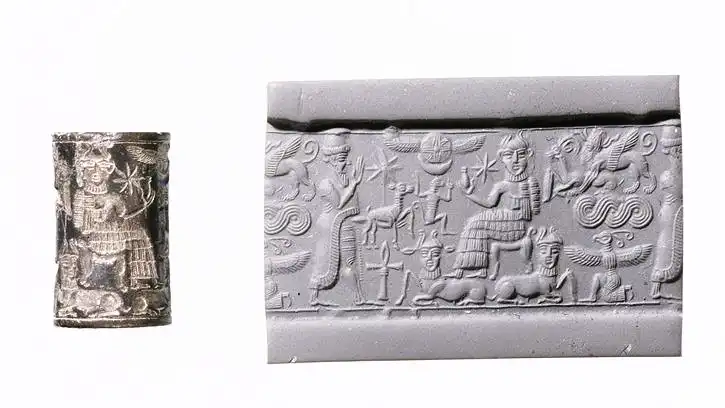
OK, here we have our first set of "clues", which are present in an ancient cylinder seal, where we can easily regard as important evidence, since it contains several of our identified codes.
This seal comes from the ancient Syrian culture (1820–1730 BCE), dating back one thousand three hundred (1,300) years before the time of Darius I and his son Xerxes. However, despite its antiquity, we can clearly observe that our codes were already present, clearly depicted, reflecting the same kind of scenario experienced by both the Persians and the Egyptians.
So, with a quick glance at this image, we can immediately see that three (3) of our codes are present:
Very interesting... however, what matters most here is identifying two new and distinct aspects that go beyond the codes already mentioned. Let’s take a look:
So, were you able to spot anything?
Yes, we know that without proper references, it’s not just difficult, it’s actually impossible. Still, let’s keep going, because we have another intriguing and ancient piece of evidence coming up. And this one will reveal a very important code. And this time, yes, we will fully unveil it to all of you.
That way, you’ll be able to understand that everything here makes perfect sense. Nothing depicted within these seals was placed there simply for aesthetics or as a ruler’s personal whim. Every detail was part of a complex framework, one that took us years to understand. And now, we’re sharing it with all of you in the best way possible. Of course, we’re not diving into every single detail, but still, within our limits, we’re ensuring this work remains freely available on the Internet.
Now, before we move on to the next step, let’s recall what we mentioned earlier... try to remember...
So let’s move forward, because we have another open code coming up for you all!
Photo credit: Cylinder seal and modern impression: Royal worshiper before a god on a throne; human-headed bulls below.
The Metropolitan Museum of Art, New York, Purchase, Raymond and Beverly Sackler Gift, 1991 |1991.368.5| - Public Domain.
Reference: Middle Kingdom of Egypt (Mark, Joshua J.. "Middle Kingdom of Egypt." World History Encyclopedia.
World History Encyclopedia, 04 Oct 2016. Web. 05 Jul 2023.).
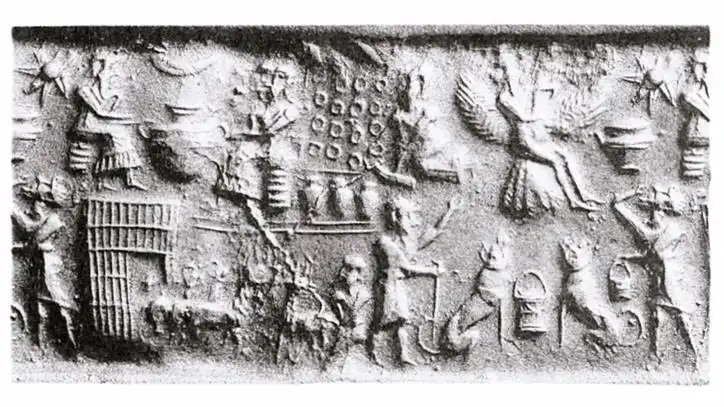
Well, now we are face to face with King Etana, our second and last set of "clues".
"King of Kish who ascended to the sky on an eagle to request the Plant of Birth from the gods, so that he could have a son"... yes, this is a brief introduction to the Myth of Etana, a story attributed to the region of Sumer. A fragment of this myth can be found among the great collections of the British Museum, originating from the library of King Ashurbanipal in Nineveh.
King Etana appears on the list of Great Sumerian Kings, where it is said that he reigned at the beginning of the 3rd millennium (3000 B.C.). Traces of this historical figure were identified on a cylindrical seal dated to the reign of Sargon of Akkad (2334 – 2279 B.C.), in the Akkadian period.
So, now let's get to our codes! But first, consider: this cylindrical seal is approximately five thousand (5,000) years old. Although some images are worn by time, it is fascinating that we can still count on its presence to this day. So, let's move on...
So, did you manage to identify it? Indeed, it is challenging to identify a "new code" amidst so much information contained in this seal, especially considering that we don't even have a precise definition of all the codes already found.
We completely understand this difficulty! However, not everything that "cannot be said" is necessarily "cannot be seen"! Because right below, when we reveal this "new code," everyone will realize how everything will begin to make sense, and that with a small adjustment of perception, yes, it will be possible to start connecting all the dots. So, let's go ahead...
Very well, now comes an important question: how and why did we identify this object as a new code?
And the answer is simple: because the combination of the codes already discovered, along with the solution for the "algorithm," plus the analogy applied to this period, and the complementary information coming from the Biblical Book, yes, reveal this answer clearly.
And then... it was simple, wasn’t it?
Of course not! And yes, we are being sarcastic here! However, we present this sequence, so that everyone can realize how much we had to learn before we were able to understand this "scenario" that unfolded five thousand (5,000) years ago, and which continued even in more recent times, close to the "year zero", with Darius I and his son Xerxes! If we can even call something from two thousand (2,000) years ago "recent"! So, having said that, do you want to see how we managed to connect all the dots and understand how all of this makes an "immense sense"?
And the best part: without going too far, or needing to search for new images or information, and without resorting to our Research Book! Where, we will simply observe the steps already taken, and then, discover the direct connection that might have gone unnoticed by you until now.
Okay, here we go...
So... if we go back to the image from Step 53 and look at the two figures in the lower left corner, we will see a "basket" similar in one of their hands. Considering the time difference between these two scenes, even with their respective cultural nuances, we have an interval of approximately two thousand five hundred (2,500) years. So now it’s our turn to ask you a straightforward question:
Yes, a simple "basket"! And represented for millennia! Could it really be something so trivial? Or does it hold a much deeper meaning?
So then... did you realize how everything begins to make sense? Civilizations, regardless of their geographical origin or historical period, always depicted what really mattered, even in their seemingly simplest elements, like this cylindrical seal. Although, for some, this detail might go unnoticed amidst a larger and more imposing scenario, such as the "basket" in the great mosaic still present on the walls of Persepolis, depicting the Great King Darius I and his son Xerxes.
That is why we said back in Step 19, in Abu Simbel, Egypt: we must observe every detail attentively, as they may be hiding the most important information! Therefore, keep that in mind, and let’s move forward, because there are only 24 steps remaining in our journey, which will bring an impressive sequence of biblical discoveries, along with the Great Sphinx and Göbekli Tepe!
But before we continue, if you’ve made it this far with us, stop and reflect...
Did you notice how it was not simple at all to get to this point? And how challenging it is to transform so many details and understandings into simple words? And did you also realize that the so, called "impressive" discoveries in the biblical lines mentioned above actually weren’t impressive at all, since they only confirmed what we had already identified years ago, when we solved the enigma of our "algorithm"?
Yes, everything fits together! It was extremely difficult for many years, but then it became an avalanche of discoveries and revelations. However, between 2013, when we found the solution to the "algorithm," and the completion of all the discoveries, both biblical and non-biblical, another nine (9) long years passed. Enough time for us to process this whirlwind. Time to reflect. And, most importantly, time to understand that if we didn't do something, no one ever would. That’s why we are here sharing this responsibility with all of you. Now, everyone knows about the potential and importance of this work, and, most importantly, they have become part of our no longer private context!
And so, we move forward towards the conclusion of our sets of "clues," scattered across civilizations and eras of history.
Photo credit: Louis Delaporte (Loches, January 11, 1842 – Paris, May 3, 1925), Public domain, via Wikimedia Commons.
References: Etana Epic (Britannica, The Editors of Encyclopaedia. "Etana Epic". Encyclopedia Britannica, 9 Aug.
2019, https://www.britannica.com/topic/Etana-Epic. Accessed 6 July 2023.) / The Myth of Etana (Mark, Joshua J..
"The Myth of Etana." World History Encyclopedia. World History Encyclopedia, 02 Mar 2011. Web. 06 Jul 2023.).
Well, as we mentioned earlier, considering our "solution for the algorithm" in relation to our "analogy", we began a new search for possible evidence in cultures beyond the Egyptian ones, which could validate this relationship more robustly. Therefore, in addition to the three (3) sets of "codes" presented above, ranging from Darius I to King Etana, we also found several other examples, which we will now demonstrate through the following list*. These examples mostly feature cylindrical seals similar to the ones presented earlier, serving as a method of representation of our "evidence/codes":
And what can we say about this list, with so many distinct cultures, geographic locations, and periods of time? Certainly, this is an impressive result, especially when we consider the complexity involved in the entire process. However, alongside these significant results, we once again faced our best and worst parts. So, let’s go straight to them:
Exactly, this would be a huge challenge, but one way or another, we would have to solve it. Since we used various pieces of information from the Biblical Book, and these allowed us, among other things, to find the same "scenarios" from Egypt in other civilizations, validating our discoveries in a precise and consistent way. But now, the question was... how would we validate the Biblical events logically, to the point of asserting, without a shadow of a doubt, the supposed truthfulness of its lines and passages?
Therefore, at that moment, we had to reflect more deeply on our achievements and make an objective assessment to see if we could find a solution! Let’s look at what we did.
Observed Algorithm (Egypt Codes 2004) Algorithm Solution (9 Years Later) Mapped Analogy (Scenarios in Human History) Complementary Information (Biblical Book) Same Codes in Other Civilizations (Identical Scenarios) Repeats the Looping...
Well, observing this sequence, we could only reach one conclusion: its lines did indeed contain a great deal of truth. However, this still did not justify that all its content and passages were entirely true and validated! Therefore, breaking down the items above objectively: the "Observed Algorithm in Egypt" depended on our action (done); the "Solution to this algorithm" also depended on our action (done, 9 years later); the "Mapped Analogy" likewise (done); finding the "Codes in Other Civilizations" was also accomplished (done); now, confirming if the whole "additional biblical context" was correct, even though it was fundamental to our discoveries, still needed to be done. And this would be, from that moment on, our next and challenging objective!
So... did our situation become clear at that point? We hope so! So, let’s continue...
Yes, everything that seemed difficult and complex, which had already taken us years of work, became something almost impossible in just a few minutes!
* References on these cultures and associated periods: Near East (Mark, Joshua J.. "Near East." World History Encyclopedia. World History Encyclopedia, 23 Oct 2022. Web. 06 Jul 2023.)
Okay, it was indeed challenging, but not impossible! And now, the best part of these long steps is about to begin! So, let’s go!